The Bible did not fall from the sky! It was created gradually before taking the form we know today. The stories, laws, prayers and poems that compose it were written at different times, meditated on, taken up, commented on and then edited and translated.

Within the framework of the Old Testament, some of these texts were transmitted orally before being written on papyri or parchments. The books of the Old Testament formed rolls which were to be kept at the Temple in Jerusalem. The Qumran manuscripts give us a good idea of what these scrolls might have been.
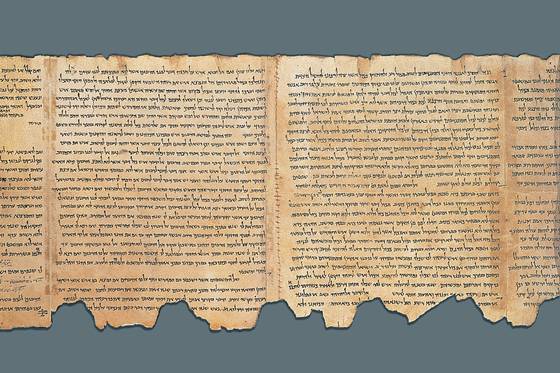
The Old Testament: a text written in three languages
The New Testament
The historical existence of Jesus Christ is no longer seriously disputed. It is moreover attested by authors who are not Christians (the Latin pagan historians Tacitus, Suetonius and Pliny the Younger speak of Christ).
He was born during the reign of King Herod the Great, probably 6 years before the start of our calendar (due to a calendar calculation error). Around the years 27-28, he will begin his public life with the baptism that Jean-Baptiste will give him. It will last 2 or 3 years and will end with his crucifixion around 30. After his death, his disciples claim to have found his empty tomb and announced his resurrection. Jesus Christ himself wrote nothing that has come down to us. The writing of the New Testament takes place in several stages.
The Age of the Apostles
After the death of Christ, from the year 30 to 70, the apostles organized the nascent communities. The primary sources are:
During the early years, the apostles proceeded in several ways. Thus, the oral tradition will begin to structure itself. Announcing the Good News: the apostles announce their new faith by moving from town to town. They seem to be preachers today. The celebration of God and of Jesus Christ: songs and liturgical elements (example: Baptism, Eucharist, etc.) are developed. The teaching to the newly baptized: the apostles take up for this the acts and the words of Christ.
Written sources
Oral traditions are written down. Without being certain on this point, specialists think that even before the writing of the Gospels as we know them, there were circulating collections of the words and life of Jesus Christ. Soon enough, catecheses, written in Aramaic, were to circulate in Judea and Galilee. We can also think that the account of the Passion was very quickly constituted in writing with a liturgical aim. It was a question for the community of Jerusalem, and for the disciples who went up to Jerusalem for Passover for example, to remember the death of Jesus. The Apostle Saint Paul writes letters to the communities he founded in Asia Minor, a letter to the community in Rome, plus the note to Philemon about his slave Onesimus who became a Christian.
The second generation of Christians
The death of the apostles makes Christians aware of the need to shape their teachings and their memories. This will lead to the writing of the Gospels and several letters, from 70 to 100 after Jesus Christ. The texts will appear according to the following chronology:
The Gospel of Mark
The first Gospel, that of Mark (65-70), was probably written in Rome.
The Gospel of Matthew
Israel is defeated by the Romans. They destroy the Temple in Jerusalem and the Jews disperse throughout the world. The Pharisee current – which are Jews attached to a rigorous respect of the Old Testament – gives its final form to the Bible. In response, to mark their identity and affirm their convictions, Christians of Jewish origin wrote the Gospel of Matthew (80-90) as well as the letters of James and Jude.
The Gospel of Luke and the Acts of the Apostles
The Churches founded by Saint Paul write in their turn (80-90). A Christian close to Saint Paul wrote the Gospel of Luke and the Acts of the Apostles (which recount the life of the first communities). The Gospel of Luke and the Acts of the Apostles are in fact the same text. Many letters will be published (Letter to the Colossians (inhabitants of the city of Colosse), to the Ephesians (inhabitants of the city of Ephesus)…
The Gospel of Saint John
The Johannine community emerges from its isolation (80-100). This group of Christians marked by theological meditation and recognizing themselves in the figure of the beloved Disciple (who will later be identified with Saint John) wrote the Gospel of Saint John and three letters (John 1, 2 and 3). In a context of persecutions, a Christian close to this community writes an Apocalypse.
The Third Generation of Christians
Some texts are written later, from 100 to 120 AD. This is particularly the case of the Epistle to the Hebrews (around 100) which testifies to a Christianity detached from Judaism, or even the Second Epistle of Saint Peter (around 120) which is a rewriting of the Epistle of Jude.
Some important dates in the transmission of the New Testament
The “Alexandrian Recension”
Remember that at the time neither the printing press nor the Internet existed. The Bibles were translated and distributed thanks to those who copied them. Over time, some copies had moved away from the original texts. Faced with the discrepancies between the manuscripts, the Church decided in the 3rd century to carry out a “recension” (comparison of the various texts with the original manuscripts). Note that another “recension” will take place in Antioch (it is called the “Western recension”). The texts that were written in Greek are translated into Latin, Coptic (for Egyptian Christians) and Syriac (for Christians from the Middle East).
The Great Complete Manuscripts of the New Testament
A new “recension” will be made in Byzantium in the 5th century. It stands out as the version common to all the Greek-speaking Churches. The great manuscripts date from this period. Their names are “Vatinacus”, “Sinaiticus”, “Alexandrinus”, “Codex of Ephrem”, “Codex of Bèze”…
Le Codex
The Codex is the ancestor of our modern books. It consists of manuscript pages and a cover assembled with a binding. During the Roman era, it will replace the parchment roll by establishing a small revolution because it allows easy access to any part of the text. It will be very quickly adopted in Christianity in order to differentiate itself from the Jews who continue to use scrolls for synagogal reading and for the study of the Bible.
From the 5th century
From the 5th century to the Renaissance, monasteries ensured the copying of texts from the Bible as well as Greek and Latin literature. From the Renaissance to the 16th century, many manuscripts flowed into the West after the fall of Constantinople (1453). The division into verses was introduced by the French printer and translator Robert Estienne at the same time.